Key Takeaways
The Cisco 9841 supports dual Gigabit Ethernet ports with integrated switching, allowing it to serve as an inline switch for connected PC workstations and eliminating the need for separate desktop switches in cost-constrained deployments.
The device is natively compatible with CUCM (up to 130 SIP lines), Webex Calling (up to 16 lines), and open SIP platforms, making it ideal for organizations undergoing UC migrations or operating hybrid on-premises/cloud environments.
Security-critical features include TPM 2.0 hardware attestation, FIPS 140-2 compliance, TLS 1.3 encryption, and Secure Erase capability for ITAD compliance—meeting regulatory requirements for finance, healthcare, and government sectors.
PoE Class 2 (IEEE 802.3af) support eliminates the need for local power adapters at each desk, reducing installation costs and cable clutter while consuming only 1.95W with the display off.
The 9841 is constructed with 74% post-consumer recycled plastic and is ENERGY STAR certified, providing quantifiable ESG reporting data points and meaningful energy cost savings across large-scale deployments.
Hot desking and customizable action buttons enable flexible workspace strategies, making the phone suitable for reception areas, conference rooms, and cost-sensitive large-scale rollouts without compromising enterprise-grade functionality.
Deploying the right VoIP endpoint can be the difference between a communication infrastructure that simply functions and one that actively drives productivity. For enterprise IT managers, mid-sized business owners, and procurement specialists evaluating modern desk phone solutions, the Cisco Desk Phone 9841 represents a compelling entry-level option within Cisco’s next-generation 9800 Series lineup. With HD audio, enterprise-grade security protocols, and eco-conscious construction, this phone is engineered to meet the operational demands of today’s hybrid work environments — without the overhead of premium-tier hardware costs.
This product spotlight examines everything IT decision-makers need to know before deploying the Cisco 9841: its core specifications, compatibility requirements, security architecture, and the deployment scenarios where it delivers the most value. Whether you’re refreshing an aging PBX environment or scaling a distributed office rollout, understanding the technical depth behind this device ensures your procurement decisions are aligned with both current needs and long-term infrastructure goals. You can browse current Cisco hardware specials to find cost-effective options for your deployment.
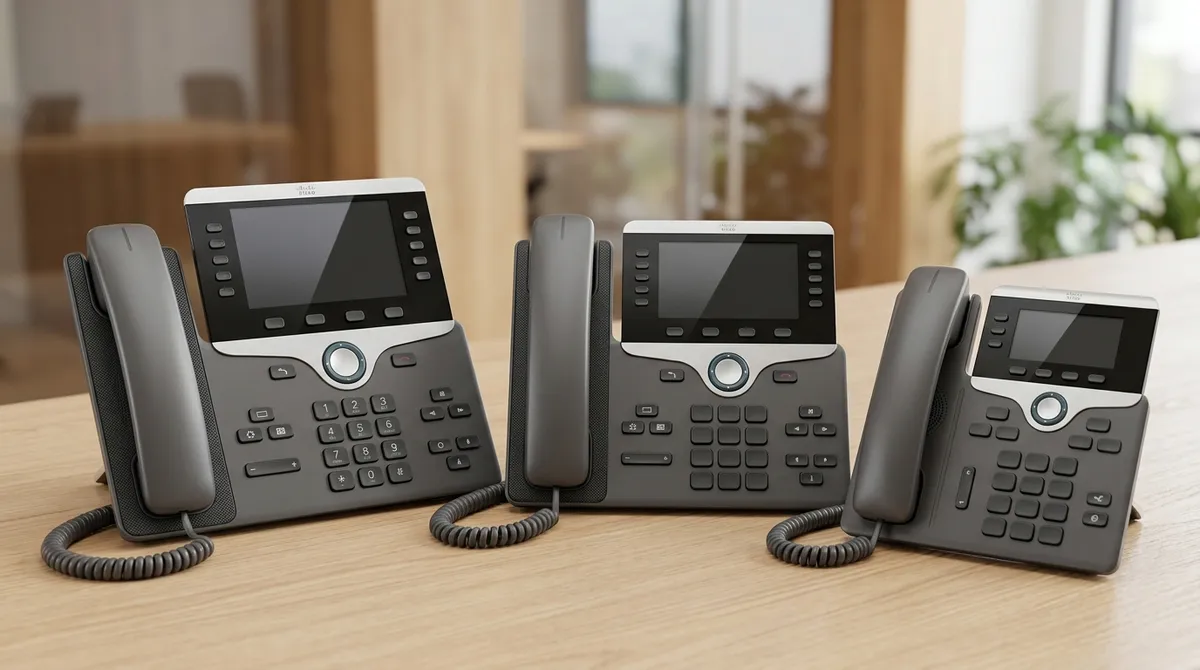
Overview of the Cisco Desk Phone 9800 Series
The 9800 Series is Cisco’s modern SIP-based desk phone platform designed to replace aging 7800 and 8800 series endpoints with a more sustainable, secure, and cloud-ready architecture. The series spans multiple tiers, from the entry-level 9841 to more feature-rich models with color displays and expanded programmable keys. Each model in the series is built on a shared firmware and security framework, making fleet management and unified communications integration consistent across the line.
The Cisco Desk Phone 9841 occupies the entry-level position in this series, making it the go-to choice for general-purpose workstations, lobbies, conference rooms, or cost-sensitive deployments where advanced display features are not a requirement. It is the ideal starting point for organizations looking to standardize on a modern, supportable platform. For enterprise procurement teams evaluating large-scale deployments, understanding where the 9841 fits within the product hierarchy is critical to right-sizing hardware investments. According to Network World, organizations that align endpoint selection with actual use-case requirements can significantly reduce per-seat hardware costs without compromising functionality.
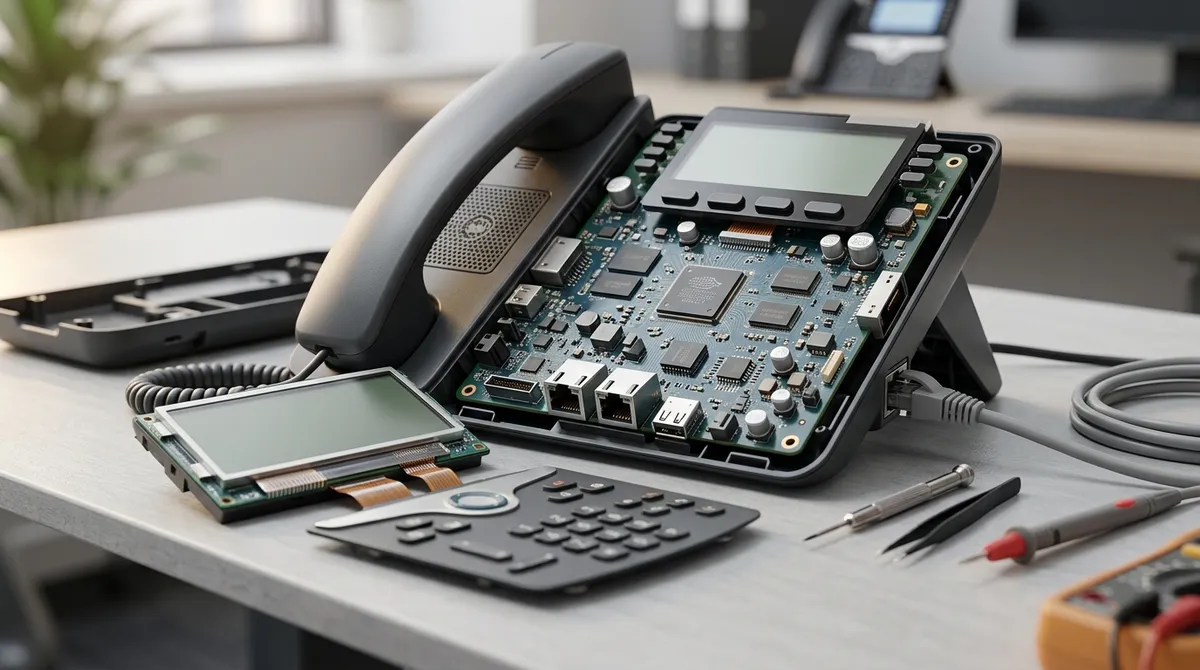
Core Technical Specifications
Before deploying any VoIP endpoint, IT teams must validate hardware specifications against infrastructure requirements. The Cisco 9841 delivers a well-balanced specification set for an entry-level device. Below is a complete technical reference table:
Specification | Detail |
|---|---|
Display | 3.5-inch backlit grayscale LCD, 384 x 160 resolution |
Programmable Line Keys | 4 |
Maximum SIP Lines (CUCM/Webex DI) | 130 |
Maximum SIP Lines (Webex Calling/Open SIP) | 16 |
Audio Codecs | G.722, Opus, G.711, G.729 |
Network Ports | Dual 10/100/1000BASE-T Ethernet (integrated switch) |
Power | PoE Class 2 (IEEE 802.3af) |
USB Port | 1x USB-A (5V / 0.25A) |
Security | TPM 2.0, FIPS 140-2, TLS 1.3, EAP-TLS, Secure Erase |
Protocols | SIP, SDP, RTCP, RTP, SRTP |
Power Consumption (display off, PoE) | 1.95W |
Dimensions | 8.43 x 8.43 x 1.94 inches (214 x 214 x 49.4 mm) |
Color | Carbon Black |
Sustainability | 74% post-consumer recycled plastic, ENERGY STAR certified |
The dual Gigabit Ethernet ports allow the phone to serve as an inline switch for a connected PC workstation — a key consideration for deployments where desktop switches are limited or cabling runs are shared. PoE Class 2 support (IEEE 802.3af) simplifies power delivery by eliminating the need for local power adapters at each desk, reducing both installation costs and cable clutter.
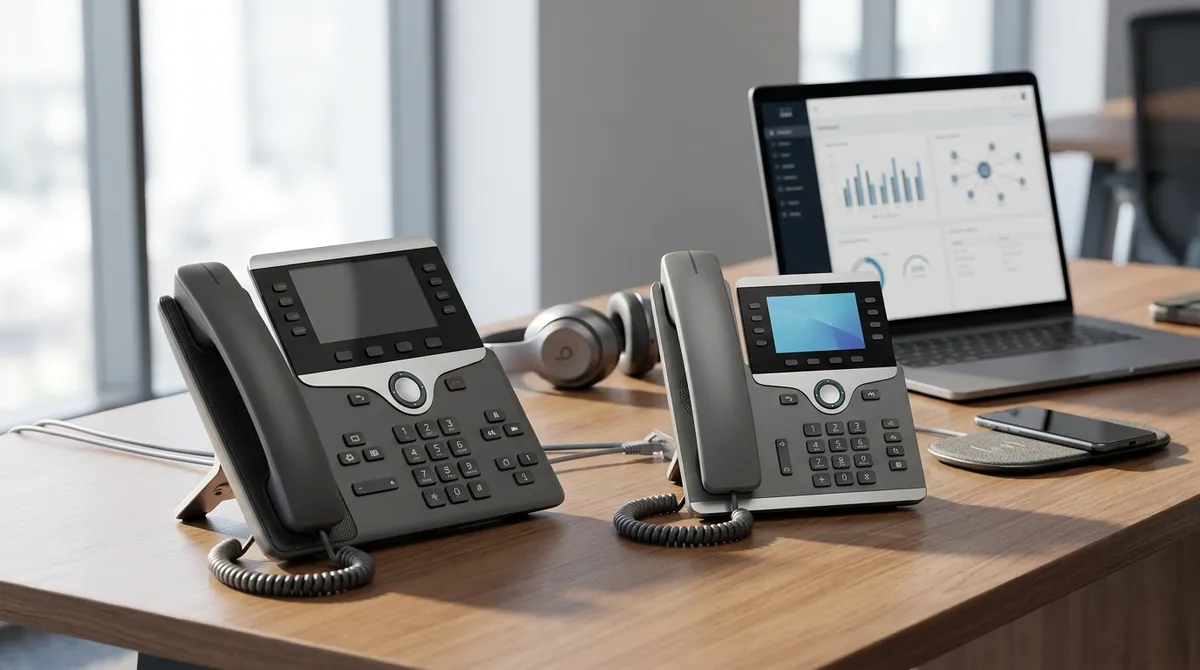
Unified Communications Platform Compatibility
One of the most critical evaluation criteria for any enterprise VoIP endpoint is its compatibility matrix with existing or planned unified communications (UC) platforms. The Cisco Desk Phone 9841 is natively compatible with the following environments:
Cisco Unified Communications Manager (CUCM): Full on-premises call control with support for up to 130 SIP lines via CUCM or Webex Device Integration (Webex DI).
Webex Calling: Cloud-based calling with up to 16 SIP lines, enabling seamless hybrid workforce communication via Cisco’s cloud infrastructure.
Open SIP Platforms: Third-party SIP call control environments are supported with up to 16 lines, providing flexibility for organizations not standardized on Cisco UC platforms.
VLAN Support: Native VLAN tagging ensures voice traffic can be segregated from data traffic on shared network infrastructure — essential for QoS enforcement.
This multi-platform compatibility makes the 9841 a practical choice for organizations undergoing UC migrations, running hybrid on-premises/cloud environments, or operating managed service contracts. IT teams evaluating deployment readiness should confirm firmware version compatibility with their specific CUCM or Webex Calling release prior to mass provisioning.

Audio Performance and User Experience
HD audio quality is a baseline expectation for modern enterprise communications. The Cisco Desk Phone 9841 delivers on this requirement through a combination of hardware and software-level audio processing technologies:
Full-duplex speakerphone for hands-free operation in private offices or small meeting spaces.
G.722 wideband and Opus codecs for HD audio quality on compatible network paths.
Acoustic Echo Cancellation (AEC) to suppress near-end echo during speakerphone calls.
Adaptive Jitter Buffer (AJB) to compensate for variable network latency and maintain audio continuity.
Multi-language display support for multinational enterprise deployments.
The 3.5-inch backlit grayscale LCD at 384 x 160 resolution provides sufficient visual real estate for caller ID, call duration, date/time, and menu navigation. While this is not a color touchscreen, the display is well-suited for users whose primary interaction with the device is traditional voice communication rather than app-based workflows. For more advanced display requirements, higher-tier models in the 9800 Series offer color LCDs and expanded feature sets.
Security Architecture
Enterprise security requirements for endpoint devices have intensified significantly. The Cisco 9841 addresses these requirements through a layered security architecture that meets federal and enterprise compliance standards. Key security capabilities include:
Security Feature | Function |
|---|---|
Trusted Platform Module (TPM) 2.0 | Hardware-based root of trust for device integrity verification |
FIPS 140-2 | Federal cryptographic module standard compliance |
TLS 1.3 | Encrypted signaling between phone and call control platform |
SRTP | Encrypted media streams for voice call privacy |
EAP-TLS | Certificate-based 802.1X network access control |
Secure Erase | Cryptographic data wipe for ITAD compliance and device redeployment |
The inclusion of TPM 2.0 is particularly noteworthy for security-conscious organizations, as it provides hardware attestation that the device firmware has not been tampered with at the hardware level. This is a critical feature for regulated industries such as finance, healthcare, and government. The Secure Erase capability also simplifies IT Asset Disposition (ITAD) workflows, ensuring that sensitive configuration data is completely removed before devices are decommissioned or redeployed.
Ideal Deployment Environments
Understanding the optimal use cases for the Cisco Desk Phone 9841 ensures that procurement decisions are appropriately matched to operational requirements. The following table outlines recommended deployment scenarios:
Deployment Scenario | Why 9841 Is Appropriate |
|---|---|
General-purpose office workstations | 4 programmable lines sufficient for standard call handling; cost-effective per-seat pricing |
Reception and front-desk areas | Wall-mountable, compact form factor; hot desking support for shift workers |
Open-plan and hybrid offices | HD audio with AEC reduces environmental noise disruption |
Conference rooms (small/huddle) | Full-duplex speakerphone for small group calls without external audio equipment |
Cost-sensitive large-scale rollouts | Entry-level pricing with enterprise-grade security and PoE support |
ITAD-compliant refresh programs | Secure Erase feature ensures data sanitization meets compliance requirements |
The hot desking capability is particularly relevant for organizations managing flexible workspace strategies, where employees rotate between assigned desks and require dynamic phone profile assignments. The customizable action button further extends usability for specific workflow configurations — such as speed dial to a help desk, one-touch conferencing, or BLF (Busy Lamp Field) monitoring.
How to Deploy the Cisco Desk Phone 9841 in Your Environment
Successful deployment of the Cisco 9841 requires systematic execution across several phases. The following step-by-step process applies to both greenfield installations and refresh scenarios within existing Cisco UC environments:
Network Infrastructure Validation: Confirm that your network switches support PoE Class 2 (IEEE 802.3af) and that VLAN configurations for voice traffic are properly defined. Verify QoS policies (DSCP markings for voice traffic) are enforced at the switch and router level.
Call Control Platform Preparation: Register the device in CUCM, Webex Calling, or your Open SIP platform. Assign directory numbers, set SRTP policies, and configure 802.1X credentials if EAP-TLS is enforced on your network access layer.
Firmware and Certificate Management: Ensure the device is running a firmware version compatible with your UC platform release. Deploy device certificates for TLS signaling and confirm TPM 2.0 attestation is functioning within your security management framework.
Physical Installation: Mount the phone on a desk stand or wall mount as required. Connect the LAN port to the network switch and the PC port to the user’s workstation if inline PC connectivity is needed. The phone will power on automatically via PoE.
User Profile and Feature Configuration: Program line keys, configure the action button for site-specific workflows, and set up hot desking profiles if applicable. Validate audio quality with test calls using G.722 codec to confirm HD audio path end-to-end.
Documentation and Asset Tagging: Record MAC addresses, assigned directory numbers, and physical locations in your CMDB (Configuration Management Database). This data is essential for lifecycle management and future ITAD processing.
For organizations without dedicated internal IT staff, Trifecta Networks offers professional services support for Cisco hardware deployments, including configuration, staging, and rollout management. This is especially valuable for mid-sized businesses executing a first-generation VoIP deployment or enterprises managing multi-site refresh programs simultaneously.
Sustainability and Total Cost of Ownership
The Cisco Desk Phone 9841’s sustainability credentials are not merely marketing positioning — they have direct implications for total cost of ownership (TCO) and corporate environmental compliance programs. Key sustainability metrics include:
74% post-consumer recycled plastic in device construction, reducing raw material extraction and supporting circular economy procurement policies.
ENERGY STAR certification, confirming the device meets energy efficiency standards for commercial electronics.
1.95W power consumption (display off, PoE) — one of the lowest in its class, translating to meaningful energy cost savings across large-scale deployments.
Long platform lifecycle support from Cisco, reducing the frequency of forced hardware refreshes driven by end-of-support timelines.
For procurement specialists managing ESG (Environmental, Social, and Governance) reporting requirements, the 9841’s recycled material content and ENERGY STAR status provide quantifiable data points that can be incorporated into annual sustainability disclosures. As noted by Tri-Net third-party maintenance services, extending the operational life of certified hardware through post-warranty maintenance further compounds TCO advantages for enterprise buyers.
Request a hardware or maintenance quote to evaluate the financial impact of third-party support on your infrastructure budget.
Conclusion
The Cisco Desk Phone 9841 is a technically sound, enterprise-validated VoIP endpoint that delivers HD audio, robust security architecture, multi-platform UC compatibility, and measurable sustainability benefits — all within an entry-level form factor and cost profile. For IT managers, procurement specialists, and network infrastructure teams, it represents a low-risk, high-value choice for general-purpose desk phone deployments at scale. Its PoE simplicity, FIPS-compliant security stack, and hot desking support make it adaptable across a wide range of enterprise environments, from large corporate campuses to distributed branch offices.
To explore available Cisco 9841 units and current pricing, check out our current Cisco hardware specials and find the right solution for your deployment. For organizations seeking expert guidance on deployment planning, ITAD programs, or extended maintenance coverage, our team is ready to support every phase of your hardware lifecycle.
FAQs
Q: What are the key specifications of the Cisco Desk Phone 9841?
A: The Cisco Desk Phone 9841 features a 3.5-inch backlit grayscale LCD (384 x 160 resolution), 4 programmable line keys, dual 10/100/1000BASE-T Gigabit Ethernet ports, PoE Class 2 (IEEE 802.3af) power support, and a USB-A port. It supports SIP, SRTP, RTP, RTCP, and SDP protocols, with HD audio via G.722 and Opus codecs, acoustic echo cancellation, and an adaptive jitter buffer for reliable voice quality.
Q: Is the Cisco Desk Phone 9841 compatible with Webex Calling and CUCM?
A: Yes, the Cisco 9841 is natively compatible with Cisco Unified Communications Manager (CUCM), supporting up to 130 SIP lines via CUCM or Webex Device Integration. For Webex Calling and Open SIP platforms, it supports up to 16 SIP lines. This multi-platform compatibility makes it suitable for both on-premises and cloud-based unified communications environments.
Q: What security features does the Cisco Desk Phone 9841 include?
A: The Cisco 9841 implements a comprehensive security stack including Trusted Platform Module (TPM) 2.0 for hardware root of trust, FIPS 140-2 cryptographic compliance, TLS 1.3 for encrypted signaling, SRTP for encrypted media streams, EAP-TLS for 802.1X certificate-based network access control, and a Secure Erase function for data sanitization during device decommissioning or redeployment.
Q: Does the Cisco Desk Phone 9841 support Power over Ethernet (PoE)?
A: Yes, the Cisco 9841 supports PoE Class 2 per the IEEE 802.3af standard, drawing as little as 1.95W in display-off mode. This eliminates the need for local power adapters at each endpoint, simplifying physical installation and reducing per-desk infrastructure costs in environments with PoE-capable network switches.
Q: Is the Cisco Desk Phone 9841 ENERGY STAR certified and eco-friendly?
A: The Cisco Desk Phone 9841 is ENERGY STAR certified and constructed using 74% post-consumer recycled plastic, making it one of the more environmentally responsible options in its product category. Its low power consumption profile and recycled material content support corporate sustainability programs and ESG reporting requirements for organizations with environmental compliance mandates.