Key Takeaways
The CW9166I-B features a dedicated fourth scanning radio enabling 24/7 WIDS/WIPS monitoring and spectrum analytics without impacting client throughput, a key differentiator from standard Wi-Fi 6 access points.
Tri-band operation (2.4 GHz, 5 GHz, 6 GHz) with 4×4:4 MU-MIMO on each band delivers 7.78 Gbps aggregate throughput, optimized for high-density environments like campuses and conference centers with minimal co-channel interference.
Cloud-native Meraki Dashboard management eliminates on-premises controller hardware and enables zero-touch provisioning for distributed deployments, significantly reducing operational costs for large-scale rollouts.
Infrastructure planning must include 2.5G or 5G multigigabit Ethernet switch ports and UPOE power capability; standard 1 Gbps switches will bottleneck the access point’s full capacity and features.
Integrated BLE radio and USB 2.0 port enable the CW9166I-B to function as a converged IoT gateway for asset tracking and sensor integration, reducing infrastructure complexity in IoT-heavy deployments.
WPA3 support, Layer 7 application firewall, Cisco ISE integration, and rogue AP containment provide comprehensive security architecture suitable for regulated industries including healthcare, finance, and government compliance frameworks.
Enterprise wireless networks in 2026 demand more than raw throughput — they require intelligent infrastructure capable of managing high device densities, ensuring security posture, and delivering consistent performance across mission-critical environments. The Cisco Meraki CW9166I-B is engineered precisely for these demands. As a tri-band Wi-Fi 6E access point from the Catalyst 9166 series, it combines cutting-edge radio technology with cloud-native management to deliver an access point that is both powerful and operationally simple. Whether you are an IT manager evaluating a campus upgrade, a procurement specialist sourcing enterprise-grade hardware, or a network infrastructure team standardizing on a scalable wireless platform, understanding the full capability of this access point is essential. This article provides a detailed technical breakdown of the CW9166I-B, including its specifications, deployment environments, security architecture, and management capabilities, to help you make an informed decision for your enterprise wireless strategy.
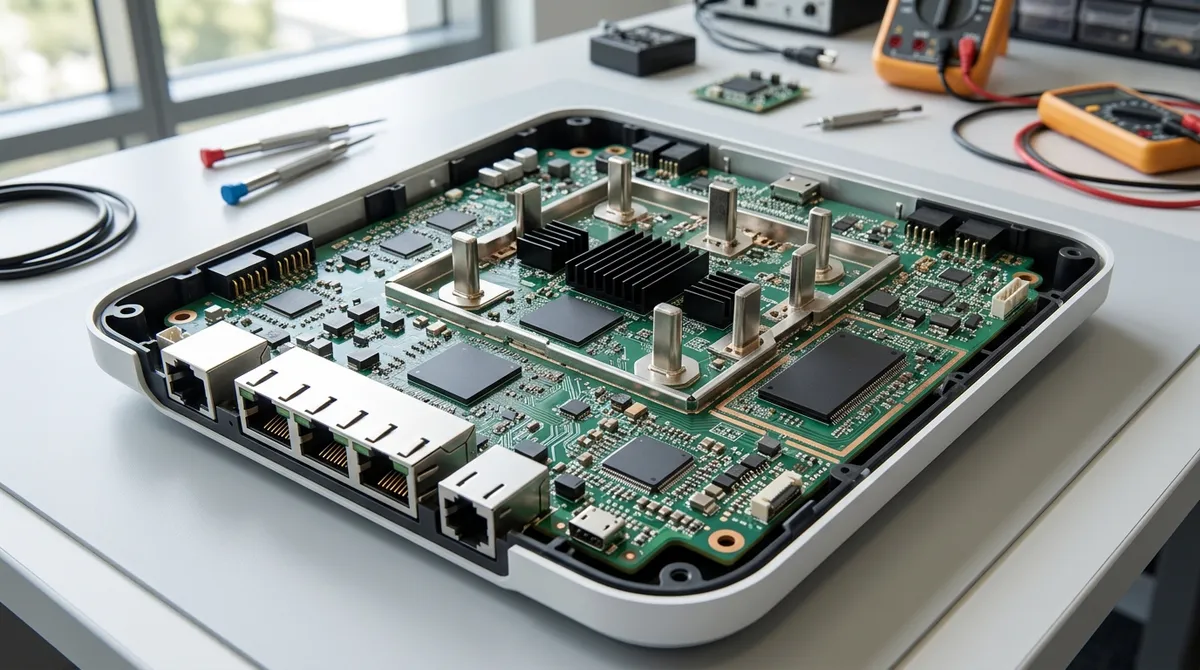
Understanding the Cisco Meraki CW9166I-B Hardware Architecture
The CW9166I-B is built on the 802.11ax (Wi-Fi 6E) standard, operating concurrently across three radio bands: 2.4 GHz, 5 GHz, and 6 GHz. Each band is equipped with 4×4:4 UL/DL MU-MIMO radios, producing an aggregate frame rate of 7.78 Gbps. This tri-radio architecture enables simultaneous client connectivity across all three bands, significantly reducing contention in high-density environments such as open-plan offices, university campuses, and conference centers.
Beyond the three client-serving radios, the CW9166I-B integrates a dedicated fourth scanning radio — a hardware differentiator that allows continuous 24×7 WIDS/WIPS monitoring, spectrum analytics, and real-time Wi-Fi location tracking without impacting client throughput. A fifth integrated Bluetooth Low Energy (BLE) radio enables beaconing, scanning, and IoT device connectivity, making this access point a converged platform for both wireless LAN and IoT infrastructure.
Core Hardware Specifications
Specification | Detail |
|---|---|
Wi-Fi Standard | 802.11ax (Wi-Fi 6E), tri-band |
Radio Bands | 2.4 GHz, 5 GHz, 6 GHz (4×4:4 MU-MIMO each) |
Aggregate Throughput | 7.78 Gbps |
Scanning Radio | Dedicated 4th radio (WIDS/WIPS, spectrum, location) |
BLE Radio | 5th integrated radio for IoT and beaconing |
Ethernet Port | 1x 5 Gbps mGig (100M/1G/2.5G/5G auto-negotiation) |
Power Options | UPOE (PoE+) or DC power input |
USB Port | USB 2.0 Type A, 4.5W power budget |
RAM / Flash | 2 GB RAM / 1 GB Flash |
Dimensions | 9.5 x 9.5 x 2.2 inches, 3.53 lbs |
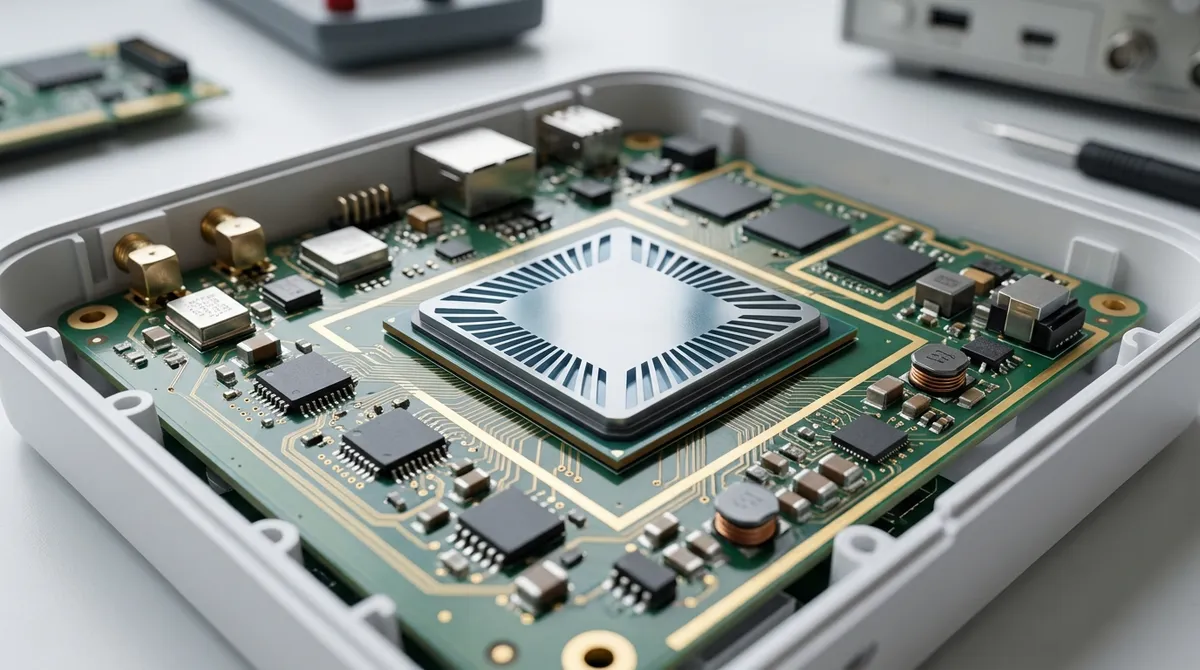
Key Technologies That Power the CW9166I-B
The CW9166I-B leverages several advanced Wi-Fi 6E technologies that collectively improve network efficiency and client performance. Understanding each technology helps network teams predict real-world outcomes during deployment planning.
Wi-Fi 6E Advanced Feature Set
OFDMA (Orthogonal Frequency Division Multiple Access): Enables simultaneous uplink and downlink transmissions to multiple clients within a single channel, reducing latency and improving spectral efficiency in dense environments.
TWT (Target Wake Time): Schedules device communication intervals to significantly reduce power consumption on IoT and mobile endpoints, extending battery life for managed devices.
BSS Coloring: Assigns color identifiers to Basic Service Sets to minimize co-channel interference in overlapping coverage areas, critical in multi-AP deployments.
Beamforming: Directs signal energy toward specific client devices, improving signal quality and throughput at distance compared to omnidirectional transmission.
MU-MIMO (Multi-User, Multiple Input, Multiple Output): Supports simultaneous spatial streams to multiple clients in both uplink and downlink directions, increasing aggregate network capacity.
These technologies, when combined with the 6 GHz band’s clean spectrum (minimal legacy device interference), make the CW9166I-B particularly effective in high-density, latency-sensitive deployments.

Optimal Deployment Environments for the CW9166I-B
Selecting the right access point for a deployment environment requires matching hardware capabilities to specific use case requirements. The CW9166I-B is purpose-built for high-density, mission-critical indoor environments where wireless performance, security, and manageability are non-negotiable.
Best-Fit Deployment Scenarios
Environment | Key Requirement Met by CW9166I-B |
|---|---|
Corporate Headquarters / Open-Plan Offices | Tri-band MU-MIMO handles high device density; OFDMA reduces latency |
University Campuses and Lecture Halls | 7.78 Gbps aggregate capacity supports simultaneous high-bandwidth users |
Healthcare Facilities | BLE IoT radio supports medical device tracking; WIPS ensures security compliance |
Conference Centers and Stadiums | 6 GHz clean spectrum minimizes interference during peak device load |
Warehouses with IoT Deployments | BLE beaconing and USB port support IoT sensor integrations |
Financial Services and Legal Offices | WPA3, Layer 7 firewall, and Cisco ISE integration support compliance requirements |
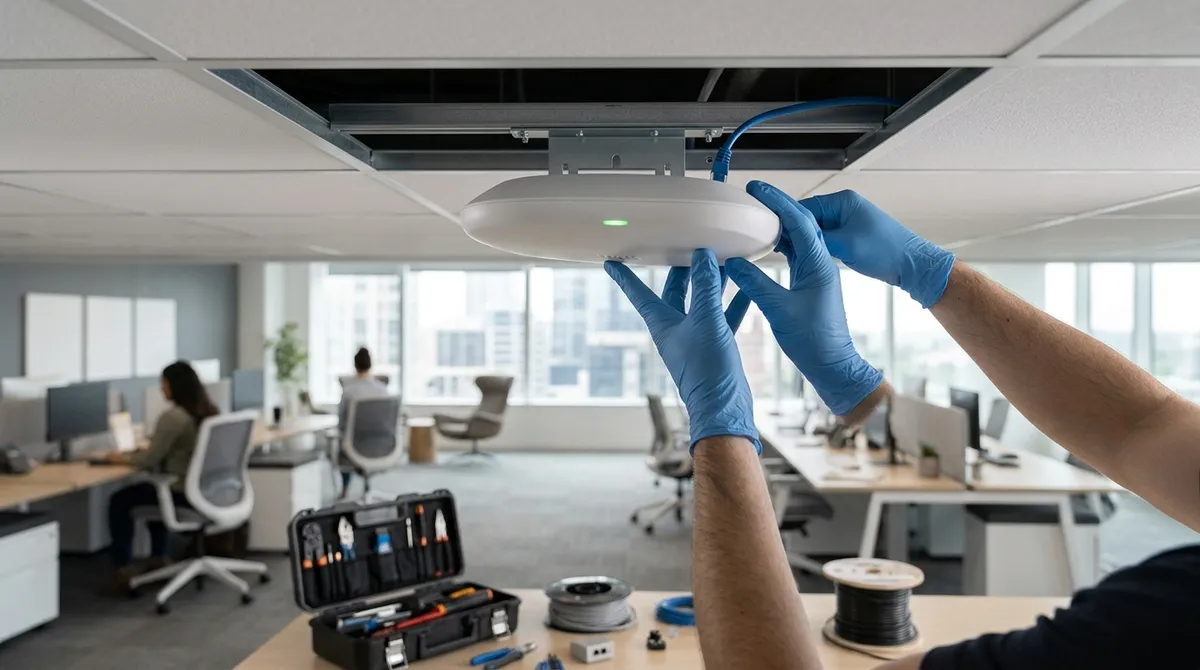
The compact form factor (9.5 x 9.5 x 2.2 inches, 3.53 lbs) ensures the CW9166I-B integrates cleanly into ceiling mount installations across diverse indoor settings. Its flexible mounting options support both standard T-bar ceiling grid and wall-mount configurations, reducing installation complexity for infrastructure teams.
Security Architecture and Enterprise Compliance
Enterprise wireless security in 2026 must address sophisticated threat vectors including rogue access points, man-in-the-middle attacks, and unauthorized client associations. The CW9166I-B’s dedicated fourth scanning radio eliminates the traditional trade-off between client service and security monitoring by providing full-time, hardware-dedicated WIDS/WIPS without consuming capacity from client-serving radios.
Integrated Security Feature Stack
24×7 Automated WIDS/WIPS: The dedicated scanning radio continuously monitors all Wi-Fi channels for intrusion events, rogue AP signatures, and anomalous traffic patterns in real time.
Rogue AP Containment: Automatically identifies and contains unauthorized access points detected within the RF environment, reducing exposure from unmanaged devices.
WPA3 Support: Enforces the latest Wi-Fi security standard, including Simultaneous Authentication of Equals (SAE), providing robust protection against dictionary and offline attacks.
Layer 7 Application-Aware Firewall: Enables policy enforcement based on application identification, allowing granular traffic control beyond traditional port/protocol rules.
Cisco ISE Integration: Supports identity-based network access control, enabling dynamic VLAN assignment, posture assessment, and role-based policy enforcement in enterprise environments.
Guest Access Management: Provides isolated guest SSIDs with configurable bandwidth limits, splash pages, and access policies to segregate guest traffic from corporate infrastructure.
For organizations in regulated industries — including healthcare, finance, and government — this layered security architecture supports compliance frameworks such as HIPAA, PCI-DSS, and FedRAMP. According to Technology Reseller News, enterprise demand for Wi-Fi 6E access points with integrated security capabilities has accelerated significantly in 2026, driven by hybrid work models and expanded IoT footprints.
Connectivity and Power Infrastructure Requirements
Proper uplink and power infrastructure planning is essential for maximizing the CW9166I-B’s capabilities. The access point’s single 5 Gbps multigigabit Ethernet port (auto-negotiating at 100M, 1G, 2.5G, or 5G) requires a corresponding mGig-capable switch port to realize full uplink capacity. Deploying the CW9166I-B on a standard 1 Gbps switch port will bottleneck aggregate throughput and limit the benefit of the 7.78 Gbps radio capacity.
Infrastructure Compatibility Checklist
Upstream switch port capable of 2.5G or 5G multigigabit Ethernet (IEEE 802.3bz compliant)
UPOE (Ultra Power over Ethernet) capable switch or injector — standard PoE+ (802.3at) provides insufficient power budget for full feature operation
Active Cisco Meraki licensing — required for cloud management, security features, and firmware updates
Optional DC power input for deployments where PoE infrastructure is unavailable
Management RJ-45 port available for out-of-band access during initial configuration or troubleshooting
Organizations evaluating the full infrastructure cost of a CW9166I-B deployment should account for switch upgrades to mGig-capable hardware if existing infrastructure does not support multigigabit speeds. For organizations looking to source the CW9166I-B alongside complementary switching infrastructure, explore available Cisco hardware specials at Trifecta Networks for cost-effective procurement options.
Application-Aware Traffic Management and QoS
The CW9166I-B includes built-in application-aware traffic shaping and Quality of Service (QoS) controls managed entirely through the Meraki Dashboard. Network administrators can define traffic policies based on Layer 7 application signatures, prioritizing latency-sensitive traffic such as VoIP, video conferencing, and real-time collaboration tools over bulk data transfers.
Traffic Prioritization Capabilities
Application identification: The access point inspects traffic flows to identify applications by signature, enabling policy enforcement beyond port-based rules.
Bandwidth limiting: Per-SSID and per-client bandwidth limits prevent individual users from monopolizing shared wireless capacity in multi-tenant environments.
Traffic shaping policies: Administrators define upload and download rate limits per application category, ensuring business-critical applications receive consistent bandwidth allocation.
Voice and video optimization: Integrated QoS mechanisms prioritize DSCP-marked traffic, reducing jitter and packet loss for real-time communications applications.
These capabilities are particularly valuable in mixed-use environments where diverse application workloads compete for wireless bandwidth — a common scenario in enterprise headquarters, educational institutions, and healthcare facilities.
IoT Integration and USB Expansion Capabilities
The fifth integrated BLE radio enables the CW9166I-B to function as a converged IoT gateway alongside its primary wireless access point role. Organizations deploying asset tracking, environmental monitoring, or proximity-based services can leverage the BLE radio for beaconing and scanning without deploying separate IoT gateway hardware, reducing infrastructure complexity and cost.
The USB 2.0 Type A port with a 4.5W power budget provides additional flexibility for connecting USB-based IoT sensors, cellular modems for out-of-band management, or other supported peripherals. This expansion capability extends the platform’s utility in verticals where physical sensor integration at the access point level is operationally advantageous, such as retail analytics or smart building deployments.
Sourcing and Procurement Considerations
For enterprise IT procurement specialists and network infrastructure teams evaluating the CW9166I-B, sourcing strategy significantly impacts total cost of ownership. Organizations should verify that all Cisco Meraki hardware is procured through authorized channels to ensure valid Meraki licensing eligibility — a prerequisite for cloud management functionality. Trifecta Networks operates as a trusted IT hardware solutions provider, offering certified pre-owned Cisco networking equipment alongside professional services and ITAD support for organizations managing hardware lifecycle transitions.
For organizations requiring ongoing maintenance support beyond manufacturer warranty terms, third-party maintenance programs offer a cost-effective alternative to OEM support contracts. Learn more about Tri-Net maintenance support to understand how Trifecta Networks extends hardware lifecycle value for enterprise wireless and networking infrastructure.
CW9166I-B vs. Standard Wi-Fi 6 Access Points: Key Differentiators
Capability | CW9166I-B (Wi-Fi 6E) | Standard Wi-Fi 6 AP |
|---|---|---|
6 GHz Band Support | Yes (1200 MHz clean spectrum) | No |
Dedicated Scanning Radio | Yes (full-time WIDS/WIPS) | Typically No |
BLE Radio | Yes (5th integrated radio) | Limited or None |
Uplink Speed | Up to 5 Gbps mGig | Typically 1 Gbps |
Aggregate Throughput | 7.78 Gbps | Typically 3-5 Gbps |
WPA3 Support | Yes | Varies by model |
Conclusion
The Cisco Meraki CW9166I-B represents a technically mature, enterprise-grade Wi-Fi 6E access point that addresses the full spectrum of requirements for high-density, mission-critical indoor deployments in 2026. Its five-radio architecture — combining three client-serving tri-band radios, a dedicated scanning radio, and an integrated BLE radio — delivers throughput capacity, continuous security monitoring, and IoT connectivity from a single compact platform. Cloud management via the Meraki Dashboard simplifies large-scale deployment and ongoing operations, while the multigigabit Ethernet uplink and UPOE power support ensure the hardware can realize its full performance potential when paired with appropriate infrastructure. For enterprise IT teams, procurement specialists, and network infrastructure professionals evaluating next-generation wireless solutions, the CW9166I-B merits serious consideration as a long-term platform investment.
Ready to evaluate the CW9166I-B for your enterprise environment? Request a customized hardware quote from Trifecta Networks and connect with our team of IT infrastructure specialists today.
FAQs
Q: What are the key specifications of the Cisco Meraki CW9166I-B access point?
A: The CW9166I-B is a tri-band 802.11ax (Wi-Fi 6E) access point featuring 4×4:4 UL/DL MU-MIMO radios across 2.4 GHz, 5 GHz, and 6 GHz bands with a 7.78 Gbps aggregate frame rate. It includes a dedicated fourth scanning radio for WIDS/WIPS, a fifth BLE radio for IoT, a 5 Gbps mGig Ethernet uplink, 2 GB RAM, 1 GB Flash, and UPOE power support in a compact 9.5 x 9.5 x 2.2-inch form factor.
Q: How does the dedicated scanning radio in the CW9166I-B improve network security?
A: The dedicated fourth radio operates continuously as a full-time WIDS/WIPS sensor, monitoring all Wi-Fi channels for rogue access points, intrusion events, and spectrum anomalies without consuming capacity from the three client-serving radios. This hardware-dedicated approach eliminates the performance compromise inherent in software-based or time-sliced scanning implementations, enabling 24×7 real-time threat detection and automated rogue AP containment.
Q: Is the Cisco Meraki CW9166I-B suitable for high-density enterprise environments?
A: Yes. The CW9166I-B is purpose-engineered for high-density deployments including corporate headquarters, university campuses, conference centers, and healthcare facilities. Its tri-band Wi-Fi 6E architecture with OFDMA, BSS Coloring, MU-MIMO, and the clean 6 GHz spectrum band collectively enable simultaneous service to large numbers of client devices with reduced contention and latency compared to dual-band Wi-Fi 6 access points.
Q: What power infrastructure is required to operate the CW9166I-B at full capability?
A: The CW9166I-B requires UPOE (Ultra Power over Ethernet) — standard PoE+ (802.3at) does not provide a sufficient power budget for full-feature operation across all radios and the USB port. An alternative DC power input is available for non-PoE deployments. The 5 Gbps mGig Ethernet uplink requires a multigigabit-capable (IEEE 802.3bz) switch port to avoid uplink bottlenecking.