Key Takeaways
The N9K-C93180YC-FX3 delivers 3.6 Tbps switching capacity and 1.2 Bpps forwarding rate in a compact 1RU form factor, making it ideal for high-density data center deployments requiring maximum rack space efficiency.
Multi-speed downlink ports (1/10/25 Gbps) and uplink ports (40/100 Gbps) enable cost-effective migration from legacy to next-generation infrastructure without requiring chassis replacement, protecting capital investments during technology transitions.
Integrated PTP boundary clock and SyncE support with ITU-T G.8275.1/G.8275.2 compliance make it suitable for telco data-center edge and 5G transport deployments requiring carrier-grade precision timing synchronization.
The switch supports advanced NX-OS features including VxLAN, telemetry, automation, and programmability with 16 GB expandable-to-32 GB memory and 128 GB SSD, enabling complex policy enforcement and monitoring without performance degradation.
Certified pre-owned units deliver identical performance specifications to new hardware at 40–70% lower acquisition cost, with full warranty coverage and multi-point testing, making large-scale deployments financially viable.
Structured deployment methodology covering pre-planning, physical installation, software configuration, and validation testing minimizes operational risk and ensures line-rate performance validation before production cutover.
Enterprise data centers and network infrastructure teams are under constant pressure to deliver higher throughput, lower latency, and greater flexibility — all while managing hardware budgets responsibly. The Cisco Nexus N9K-C93180YC-FX3 addresses these demands with a purpose-built, high-density switching platform designed for modern data center and enterprise edge deployments. Whether you are upgrading an existing fabric or building a greenfield architecture, understanding how to deploy this switch effectively can have a significant impact on network performance and total cost of ownership.
This product spotlight covers the key specifications, optimal deployment environments, configuration considerations, and practical guidance for IT managers, data center operators, and network infrastructure teams evaluating the N9K-C93180YC-FX3. For organizations sourcing pre-owned or refurbished networking equipment, partners like Trifecta Networks offer access to Cisco hardware that delivers enterprise-grade performance at reduced acquisition cost.
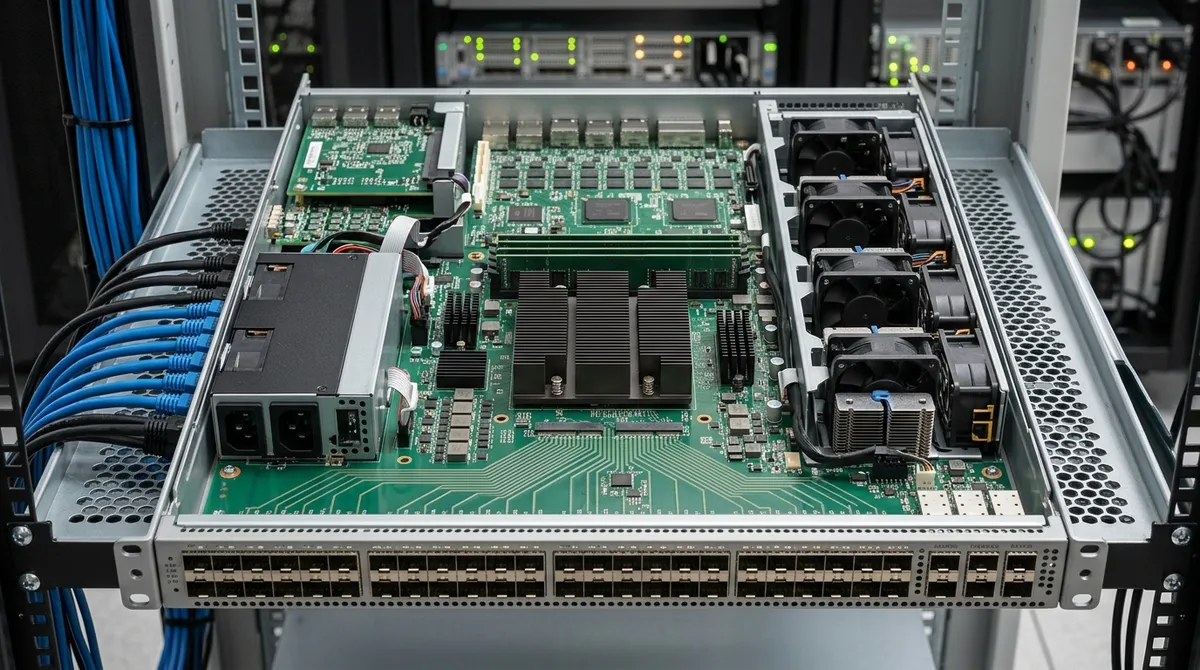
Understanding the N9K-C93180YC-FX3 Hardware Architecture
The Cisco Nexus N9K-C93180YC-FX3 is a fixed-configuration, 1-rack unit (1RU) switch from the Nexus 9300-FX3 Series. It is engineered for high-density, high-speed data center switching with a streamlined physical footprint that maximizes rack space efficiency. The switch’s architecture delivers 3.6 Tbps of switching capacity and a forwarding rate of 1.2 Bpps (billion packets per second), making it well-suited for bandwidth-intensive workloads.
The internal compute resources support advanced NX-OS feature sets, including telemetry, automation, and programmability frameworks. With a 4-core CPU, 16 GB of default system memory (expandable to 32 GB), a 128 GB SSD drive, and 40 MB of system buffer, the switch is equipped to handle complex policy enforcement and monitoring tasks without compromising forwarding performance.
Key Hardware Specifications at a Glance
Specification | Detail |
|---|---|
Form Factor | 1RU Fixed Configuration |
Switching Capacity | 3.6 Tbps |
Forwarding Rate | 1.2 Bpps |
Downlink Ports | 48 x 1/10/25-Gbps SFP28 |
Uplink Ports | 6 x 40/100-Gbps QSFP28 |
System Memory | 16 GB (expandable to 32 GB) |
Storage | 128 GB SSD |
System Buffer | 40 MB |
Max Power Consumption | 600W (AC/DC) |
Chassis Weight | 21 lbs (9.52 kg) |
Operating Temperature | 32–104°F (0–40°C) |
Physical Dimensions | 1.72 x 17.3 x 19.6 inches |

Optimal Deployment Environments
The N9K-C93180YC-FX3 is designed for several specific deployment scenarios where its port density, speed flexibility, and feature set deliver the highest value. Understanding which environment best aligns with your infrastructure requirements is critical to maximizing return on investment.
Top Deployment Use Cases
Top-of-Rack (ToR) Data Center Switching: The 48-port SFP28 downlink configuration makes this switch ideal for top-of-rack deployments, connecting servers operating at 1, 10, or 25 Gbps directly to the fabric. Its 1RU form factor minimizes rack space consumption while supporting high server density.
Spine-Leaf Fabric Architecture: When deployed as a leaf switch in a spine-leaf topology, the N9K-C93180YC-FX3 provides high-bandwidth east-west traffic forwarding with deterministic latency, a critical requirement for distributed application workloads and containerized environments.
Telco Data-Center Edge Environments: The switch supports standard PTP telecom profiles with SyncE and PTP boundary clock functionality, making it suitable for telco data-center edge deployments requiring precise timing synchronization.
Enterprise Campus Core and Aggregation: For enterprise environments that require flexible port-speed migration — transitioning from 10 Gbps to 25 Gbps without forklift upgrades — the multi-speed downlink ports provide a cost-effective upgrade path.
Environment Suitability Comparison
Deployment Scenario | Key Benefit | Critical Feature Used |
|---|---|---|
Top-of-Rack (ToR) | High server density, minimal footprint | 48 x SFP28 downlinks |
Spine-Leaf Leaf Node | Deterministic east-west latency | 3.6 Tbps switching capacity |
Telco Edge | Precision timing synchronization | SyncE + PTP boundary clock |
Enterprise Core/Aggregation | Multi-speed migration flexibility | 1/10/25G downlinks, 40/100G uplinks |
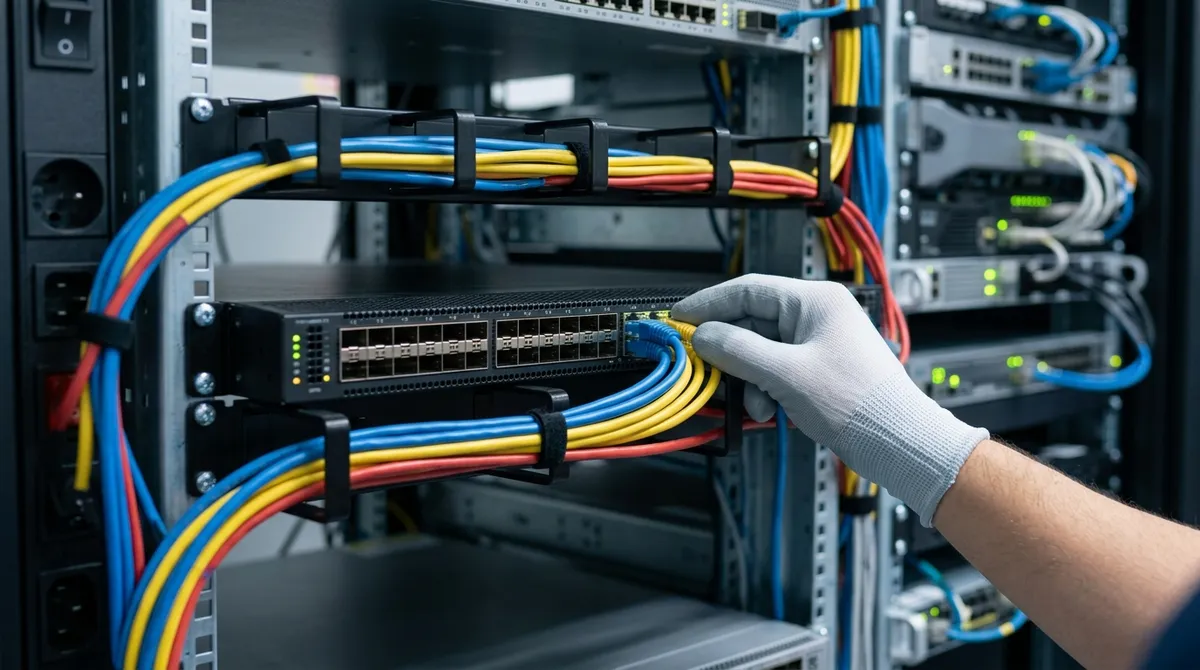
Step-by-Step Deployment Guidance
Deploying the Cisco Nexus N9K-C93180YC-FX3 effectively requires systematic planning across physical installation, software configuration, and operational management phases. The following steps outline a structured approach applicable to most enterprise and data center deployments.
Pre-Deployment Planning: Conduct a thorough infrastructure assessment to map existing cabling, power availability, and rack positions. Confirm that your data center environment falls within the operating temperature range of 32–104°F (0–40°C) and that available power circuits can support the 600W maximum draw. Validate NX-OS version compatibility with your existing Nexus fabric.
Physical Installation: Mount the 1RU chassis in the target rack position, ensuring adequate airflow clearance both front-to-back. Connect redundant power supply units to separate power circuits to maximize fault tolerance. The 21 lb (9.52 kg) chassis requires standard rack mounting hardware and two-person installation for safe handling.
Initial Software Configuration: Access the switch via the console port to configure hostname, management IP, NTP synchronization, and initial user credentials. Enable NX-OS features relevant to your deployment (e.g., OSPF, BGP, VxLAN, PTP) based on your network design. Validate software licensing to ensure all required feature sets are active.
Port Speed and Transceiver Configuration: Configure downlink SFP28 ports to the appropriate operating speed (1, 10, or 25 Gbps) based on connected device capabilities. Install Cisco-compatible QSFP28 transceivers on the 6 uplink ports and configure them for 40 or 100-Gbps operation depending on uplink fabric requirements.
Telemetry and Monitoring Enablement: Activate NX-OS streaming telemetry to export interface counters, CPU/memory utilization, and buffer utilization data to your network management platform. Leverage the 128 GB SSD for local log storage to support forensic analysis and compliance requirements.
Validation and Acceptance Testing: Execute traffic tests using a network traffic generator to validate forwarding performance at line rate. Confirm ECMP load balancing, loop prevention (STP or MSTP), and uplink failover behavior prior to production cutover.

Port Flexibility and Speed Migration Strategy
One of the most operationally significant features of the Cisco Nexus N9K-C93180YC-FX3 is its multi-speed port architecture. The 48 downlink SFP28 ports support 1, 10, and 25-Gbps operation, enabling organizations to connect legacy 1/10GbE servers alongside next-generation 25GbE compute infrastructure on the same switch platform. This eliminates the need for separate switch platforms during migration phases.
The 6 QSFP28 uplink ports similarly support 40 or 100-Gbps configurations, providing a clear upgrade path as uplink bandwidth demands increase. Organizations can begin deployments at 40 Gbps and transition to 100 Gbps by replacing transceivers rather than chassis, preserving the initial hardware investment. According to Technology Reseller News, multi-speed flexibility is one of the top hardware selection criteria for enterprise data center refreshes in 2026.
Port Configuration Options
Port Type | Quantity | Supported Speeds | Transceiver Type |
|---|---|---|---|
Downlink Ports | 48 | 1 / 10 / 25 Gbps | SFP28 |
Uplink Ports | 6 | 40 / 100 Gbps | QSFP28 |
Telco Edge and Timing Synchronization Capabilities
For network operators deploying the N9K-C93180YC-FX3 at the telco data-center edge, the integrated PTP (Precision Time Protocol) and SyncE (Synchronous Ethernet) support is a critical differentiator. The switch operates as a PTP boundary clock, enabling precise timing distribution across the network fabric — a fundamental requirement for 5G transport, financial services infrastructure, and distributed media workloads.
Standard PTP telecom profiles (ITU-T G.8275.1/G.8275.2) are supported, ensuring interoperability with carrier-grade timing infrastructure. This positions the N9K-C93180YC-FX3 as a viable option for operators building converged IT/OT data center edge environments where timing accuracy requirements are stringent.
Third-Party Maintenance and Hardware Lifecycle Considerations
Enterprise organizations deploying the Cisco Nexus N9K-C93180YC-FX3 should incorporate hardware lifecycle management into their operational planning from day one. As this switch matures within your infrastructure, transitioning from vendor-provided support to third-party maintenance can generate substantial cost savings without compromising uptime or response times.
Extended hardware life cycles beyond standard vendor End-of-Life (EoL) dates reduce forced refresh cycles and capital expenditure pressure.
Third-party maintenance agreements typically deliver equivalent SLA coverage at 40–70% lower annual cost compared to OEM support contracts.
Spare parts availability for the N9K-C93180YC-FX3 through authorized resellers and refurbished equipment channels ensures business continuity even after vendor support sunset.
ITAD (IT Asset Disposition) services allow responsible decommissioning of replaced hardware, recovering residual value and ensuring environmentally compliant disposal.
Trifecta Networks provides third-party maintenance support through its Tri-Net program, specifically designed to extend the operational life of enterprise networking hardware including Cisco Nexus platforms. You can learn more about Tri-Net third-party maintenance and how it can reduce your annual support costs while maintaining enterprise-grade SLAs.
Sourcing Considerations: New vs. Refurbished
IT procurement specialists evaluating the N9K-C93180YC-FX3 should conduct a thorough cost-benefit analysis when choosing between new and certified pre-owned (CPO) units. Refurbished Cisco Nexus hardware that has been factory-tested and certified meets the same technical specifications as new units at a significantly reduced acquisition price — a critical consideration when deploying multiple switches across a large data center fabric.
Certified pre-owned N9K-C93180YC-FX3 units typically carry full hardware warranties from authorized resellers.
CPO hardware undergoes multi-point inspection and testing to validate all port, power, and system functionality prior to shipment.
Organizations can reinvest acquisition cost savings into additional switches, software licensing, or professional services to accelerate deployment timelines.
If your organization is actively sourcing Cisco Nexus hardware, check out current Cisco hardware specials to find available N9K-C93180YC-FX3 inventory and pricing options that align with your procurement budget.
Conclusion
The Cisco Nexus N9K-C93180YC-FX3 is a technically compelling switching platform that delivers enterprise-grade performance, deployment flexibility, and advanced feature support within a compact 1RU form factor. Its 3.6 Tbps switching capacity, multi-speed port architecture, PTP/SyncE timing capabilities, and robust NX-OS feature set make it a strong candidate for top-of-rack, spine-leaf, telco edge, and enterprise core deployments in 2026 and beyond. By following a structured deployment methodology and incorporating lifecycle management planning, organizations can maximize the operational and financial value of this hardware investment.
To explore pricing options and availability for the N9K-C93180YC-FX3, or to inquire about third-party maintenance solutions, request a personalized quote from our team today.
FAQs
Q: What is the switching capacity and forwarding rate of the Cisco Nexus N9K-C93180YC-FX3?
A: The Cisco Nexus N9K-C93180YC-FX3 delivers a switching capacity of 3.6 Tbps and a forwarding rate of 1.2 Bpps (billion packets per second). These figures make it capable of sustaining line-rate performance across all 48 downlink and 6 uplink ports simultaneously under production traffic conditions.
Q: What port speeds does the N9K-C93180YC-FX3 support on its downlink and uplink interfaces?
A: The switch features 48 downlink ports based on SFP28 optics supporting 1, 10, or 25-Gbps Ethernet, and 6 uplink ports using QSFP28 optics configurable for 40 or 100-Gbps Ethernet. This multi-speed architecture provides investment protection and eliminates the need for chassis replacement when migrating to higher port speeds.
Q: Is the Cisco Nexus N9K-C93180YC-FX3 suitable for telco data-center edge deployments?
A: Yes. The N9K-C93180YC-FX3 supports standard PTP telecom profiles including ITU-T G.8275.1/G.8275.2, along with SyncE and PTP boundary clock functionality. These capabilities make it appropriate for telco data-center edge environments where precision timing synchronization is a mandatory infrastructure requirement.
Q: What are the power consumption and system memory specifications for the N9K-C93180YC-FX3?
A: The switch has a maximum power consumption of 600W (AC/DC) and ships with 16 GB of default system memory, expandable to 32 GB. It also includes a 128 GB SSD for local storage and a 40 MB system buffer to support telemetry logging, policy processing, and NX-OS feature operations.
Q: Can the Cisco Nexus N9K-C93180YC-FX3 be sourced as a certified pre-owned unit?
A: Yes. The N9K-C93180YC-FX3 is available through authorized resellers as a certified pre-owned (CPO) unit that has undergone multi-point hardware testing to validate full functionality. Sourcing CPO hardware can reduce acquisition costs significantly while retaining the same technical performance as new units, particularly when deploying at scale across a data center fabric.