Key Takeaways
The MR57’s five-radio architecture separates data transmission from security functions, with a dedicated WIDS/WIPS radio providing continuous threat detection without impacting performance—critical for high-availability enterprise environments.
Wi-Fi 6E tri-band support with up to 8.35 Gbps aggregate throughput and 4,800 Mbps on 6 GHz band eliminates spectrum congestion, enabling consistent performance in dense corporate offices, campuses, and healthcare facilities with mixed device types.
Software-defined flex radio allows administrators to toggle between dual 5 GHz and full tri-band mode via the Meraki dashboard, extending hardware operational value as 6 GHz-capable devices proliferate without requiring access point replacement.
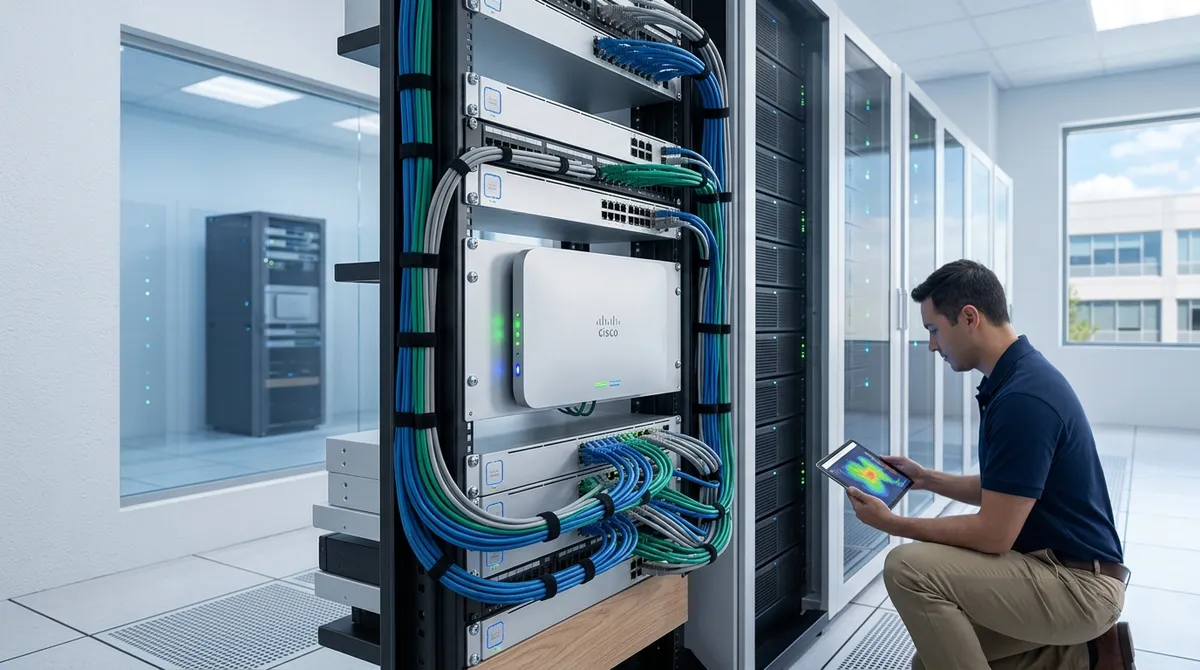
Cloud-managed operations eliminate on-premises wireless controllers, enabling zero-touch provisioning, automated firmware updates, and real-time RF visualization across distributed sites—reducing deployment labor and total cost of ownership.
Layer 7 firewall with application-aware traffic shaping allows blocking or prioritizing specific applications (video streaming, peer-to-peer) directly from the dashboard, ensuring mission-critical services maintain required bandwidth in congested networks.
Dual 5 Gbps multigigabit Ethernet ports with PoE+ and PoE++ support, plus USB 2.0 connectivity, enable integration into existing enterprise infrastructure without costly retrofits, with straightforward ceiling-mount installation compatible with standard drop-ceiling grids.
Enterprise wireless networks are under more strain than ever. Video conferencing, IoT proliferation, real-time analytics, and hybrid work models demand access points that can handle extreme density, deliver consistent throughput, and maintain airtight security — all without burdening IT staff with complex configurations. The Cisco Meraki MR57 was engineered to meet exactly these requirements. As Meraki’s flagship Wi-Fi 6E indoor access point, the MR57 brings tri-band 802.11ax performance, dedicated scanning radios, and cloud-managed intelligence into a single, enterprise-grade unit. Whether you are an IT manager overseeing a multi-floor campus, a procurement specialist sourcing hardware replacements, or a network infrastructure team extending the life of a sprawling wireless deployment, understanding what the MR57 delivers — and where it excels — is essential before making a purchasing or upgrade decision. This article breaks down the MR57’s architecture, specifications, ideal use cases, and deployment considerations with the precision your infrastructure decisions require.
Cisco Meraki MR57 Core Architecture and Radio Design
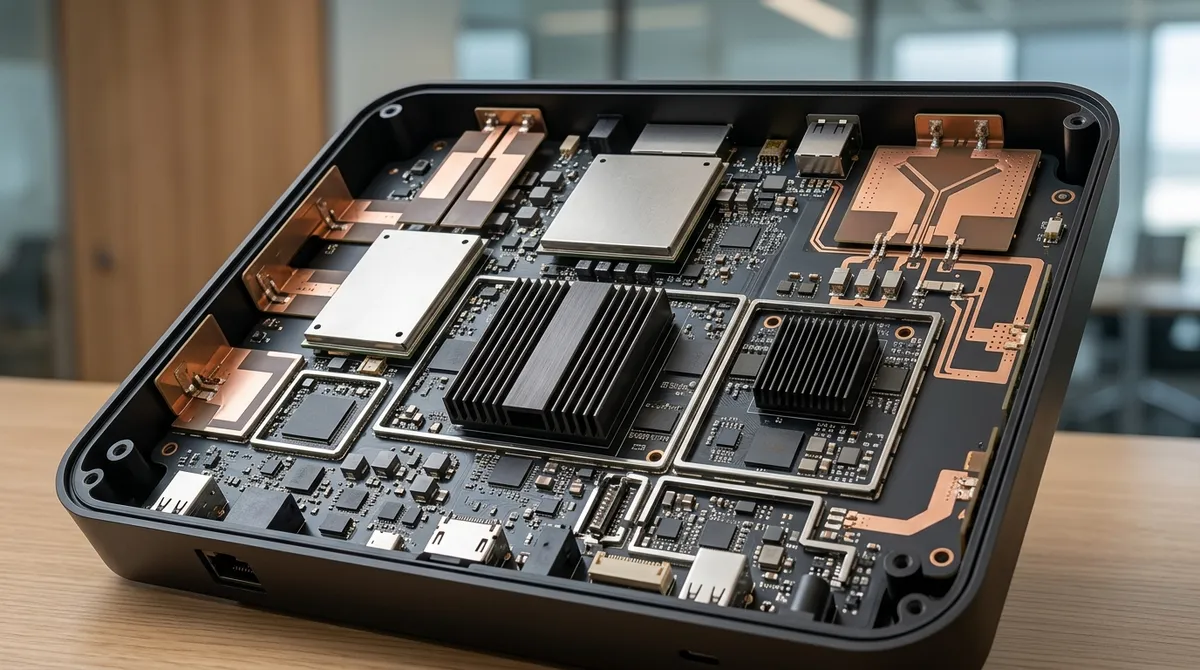
The MR57 is built on a five-radio architecture, a deliberate design choice that separates data transmission duties from security and management functions. Three primary radios handle client traffic across the 2.4 GHz, 5 GHz, and 6 GHz bands simultaneously, each supporting 4×4:4 MU-MIMO (Multi-User, Multiple Input, Multiple Output). This configuration enables the MR57 to achieve aggregate frame rates between 7.78 and 8.35 Gbps, making it one of the highest-throughput indoor access points available for enterprise environments. According to Tom’s Hardware, Wi-Fi 6E’s expansion into the 6 GHz band is a transformative step for enterprise wireless, eliminating the congestion that has historically plagued the 2.4 GHz and 5 GHz bands.
The fourth radio operates as a dedicated sensor for 24/7 real-time Wireless Intrusion Detection and Prevention System (WIDS/WIPS), spectrum analytics, and automated RF optimization. This means the MR57 never has to take a primary radio offline to perform security scans — a critical architectural advantage in high-availability environments. The fifth radio is dedicated to Bluetooth Low Energy (BLE) scanning and beaconing, enabling asset tracking, proximity-based applications, and IoT device discovery without consuming Wi-Fi bandwidth.
Software-Defined Flex Radio Capability
One of the MR57’s most operationally significant features is its software-defined flex radio. This capability allows network administrators to toggle the access point between dual 5 GHz mode and full tri-band mode through the Meraki dashboard. In high-density 5 GHz environments where the 6 GHz band is not yet fully utilized, running dual 5 GHz radios can reduce co-channel interference and maximize per-client throughput. As 6 GHz-capable devices become more prevalent across your fleet, the flex radio can be reconfigured to enable the full tri-band spectrum — extending the hardware’s operational value without replacement.
Technical Specifications at a Glance
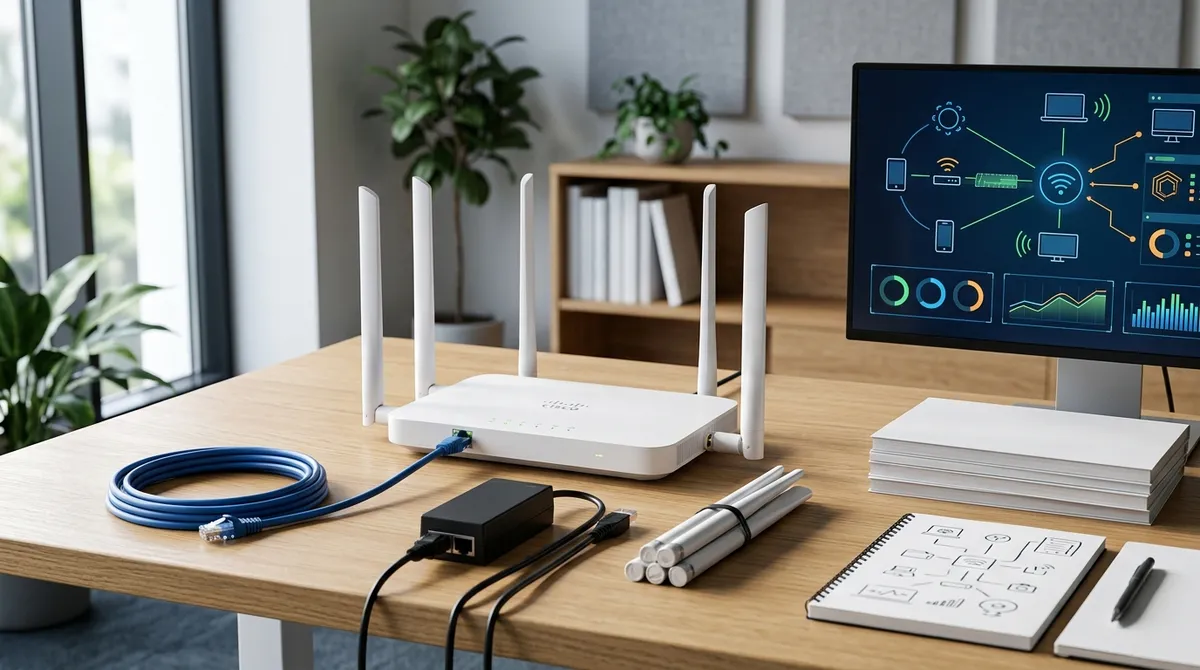
Understanding the MR57’s hardware parameters is essential for accurate network planning. The following table summarizes the key technical specifications relevant to enterprise deployment decisions.
Specification | Detail |
|---|---|
Wi-Fi Standard | 802.11ax (Wi-Fi 6E), tri-band |
Bands | 2.4 GHz, 5 GHz, 6 GHz (concurrent) |
MIMO Configuration | 4×4:4 MU-MIMO per band |
Aggregate Frame Rate | Up to 8.35 Gbps |
6 GHz Max Throughput | Up to 4,800 Mbps (160 MHz channels) |
Ethernet Ports | Dual 5 Gbps multigigabit (RJ-45) |
USB Interface | USB 2.0 Type A (9.5W power budget) |
PoE Support | 802.3at (PoE+) and 802.3bt (42.5–57V) |
Antenna Gain (2.4 GHz) | 4.5 dBi (integrated omni-directional) |
Antenna Gain (5/6 GHz) | 5.5 dBi (integrated omni-directional) |
Dimensions | 260 x 260 x 56 mm |
Weight | 1.7 kg |
Operating Temperature | 0°C to 40°C (32°F to 104°F) |
Advanced Wi-Fi 6E Features That Drive Enterprise Performance
Beyond raw radio specifications, the MR57 incorporates several Wi-Fi 6E protocol-level technologies that directly translate into measurable network improvements in dense enterprise environments.
OFDMA (Orthogonal Frequency Division Multiple Access): Divides each channel into sub-channels, enabling simultaneous transmission to multiple clients and dramatically reducing latency in high-density scenarios.
BSS Coloring: Differentiates overlapping Basic Service Sets at the radio layer, reducing co-channel interference in environments with multiple access points operating in close proximity.
Target Wake Time (TWT): Allows the AP to schedule client wake intervals, reducing contention and extending battery life for IoT and mobile devices on the network.
MU-MIMO (Downlink and Uplink): Enables the MR57 to communicate with multiple clients simultaneously rather than sequentially, increasing overall network efficiency under load.
160 MHz Channel Support on 6 GHz: Delivers peak throughput of up to 4,800 Mbps on the 6 GHz band, critical for bandwidth-intensive applications such as 4K/8K video streaming and large file transfers.
These capabilities combine to make the MR57 not just a high-throughput access point but a network efficiency engine. As noted by Network World, the adoption of Wi-Fi 6E in enterprise settings is accelerating as organizations recognize the performance ceiling limitations of earlier Wi-Fi generations in high-density scenarios.
Security Architecture: Beyond Basic Wireless Protection
The Cisco Meraki MR57 treats security as an architectural concern, not an add-on feature. Its dedicated WIDS/WIPS radio continuously monitors all three operating bands for rogue access points, deauthentication attacks, evil twin attacks, and unauthorized client associations — without impacting data radio performance. This full-time security posture is a significant operational advantage over access points that must divert a data radio for scanning duties, which introduces coverage gaps or performance degradation.
Layer 7 Firewall and Application-Aware Traffic Shaping
The MR57 integrates a Layer 7 firewall that identifies and enforces policies at the application level. Administrators can block, prioritize, or throttle specific applications — such as video streaming services during business hours or peer-to-peer file sharing — directly from the Meraki dashboard. This application-aware traffic shaping ensures that mission-critical applications receive the bandwidth they require, even in congested network environments. Combined with guest access segmentation and per-SSID VLAN tagging, the MR57 supports complex enterprise network topologies without additional hardware.
Ideal Deployment Environments for the Cisco Meraki MR57
The MR57’s architecture is optimized for high-density, performance-intensive deployments. The following table outlines the environments where the MR57 delivers the greatest operational return.
Environment | Key MR57 Advantage | Primary Features Utilized |
|---|---|---|
Corporate Offices | Supports dense device counts with consistent per-client throughput | OFDMA, MU-MIMO, Layer 7 QoS |
Higher Education Campuses | Handles thousands of concurrent students across mixed device types | Tri-band, flex radio, BSS coloring |
Healthcare Facilities | Supports medical IoT, voice over Wi-Fi, and strict security compliance | BLE radio, WIDS/WIPS, TWT |
Retail and Hospitality | Enables guest segmentation, location services, and POS reliability | Guest SSID, Wi-Fi location tracking, BLE beaconing |
Warehouses and Logistics | Supports mobile scanning devices and real-time asset tracking | BLE scanning, extended throughput |
Power, Connectivity, and Physical Installation
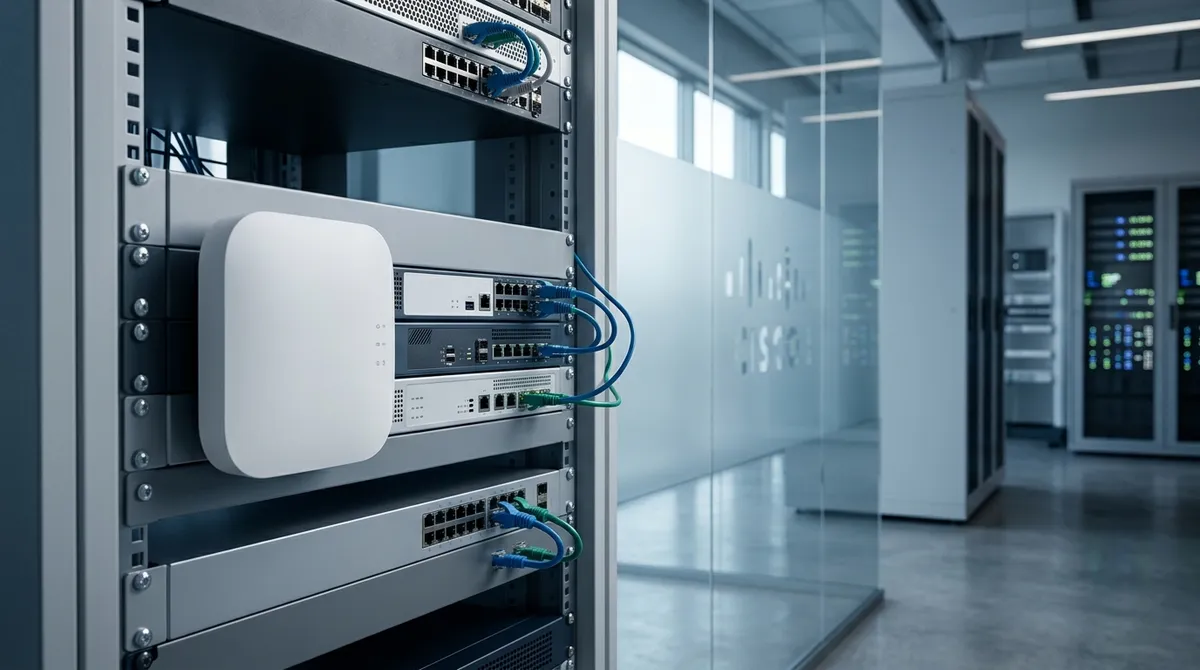
The MR57 is designed to integrate into existing enterprise cabling infrastructure without costly retrofits. It supports both 802.3at (PoE+) and 802.3bt standards, providing deployment flexibility across facilities with varying PoE switch capabilities. The dual 5 Gbps multigigabit Ethernet ports support link aggregation or separate wired and management traffic paths, enabling the MR57 to serve as a high-throughput wireless aggregation point in network segments with demanding uplink requirements.
Physical installation is straightforward. The MR57 ships with a ceiling mount bracket compatible with standard drop-ceiling T-bar grids. Its 260 x 260 x 56 mm form factor and 1.7 kg weight are consistent with enterprise ceiling tile dimensions. The integrated omni-directional antennas eliminate the need for external antenna accessories in standard indoor deployments, reducing installation complexity and maintaining a clean aesthetic appropriate for customer-facing or executive environments.
USB 2.0 Interface Applications
The USB 2.0 Type A port with a 9.5W power budget supports peripheral device connectivity at the access point level. Common enterprise applications include connecting USB-based cellular modem dongles for WAN failover, attaching USB storage for local content caching, or powering small IoT gateway devices that require physical co-location with the wireless infrastructure. This feature is particularly valuable in retail and branch office deployments where minimizing separate powered devices reduces complexity and cost.
Band Comparison: Dual-Band vs. Tri-Band Mode on the MR57
Understanding when to deploy the MR57 in dual 5 GHz mode versus full tri-band mode is a critical configuration decision that affects network performance and client distribution.
Configuration Mode | Active Bands | Best Use Case | Primary Benefit |
|---|---|---|---|
Tri-Band Mode | 2.4 GHz + 5 GHz + 6 GHz | Mixed-device environments with 6E-capable clients | Maximum spectrum utilization and client distribution |
Dual 5 GHz Mode | 2.4 GHz + 5 GHz (x2) | High-density legacy device environments | Reduced co-channel interference on 5 GHz |
Sourcing the Cisco Meraki MR57 Through Authorized Resellers
For enterprise IT managers and procurement specialists, sourcing the Cisco Meraki MR57 through a reliable, authorized channel is as important as the hardware specifications themselves. Access to genuine firmware, valid Meraki licensing, and post-sale support are non-negotiable requirements for enterprise deployments. Trifecta Networks provides access to Cisco networking hardware, including Meraki solutions, and supports enterprise customers with procurement, licensing, and professional services. Organizations seeking current Cisco pricing and availability can explore available Cisco hardware specials to identify cost-effective options aligned with budget requirements.
For teams that require post-deployment maintenance coverage beyond standard manufacturer terms, third-party maintenance programs offer a practical path to extending hardware life cycles and reducing support costs. Learn more about Tri-Net third-party maintenance support to understand how enterprise network teams can maintain uptime without the premium cost of OEM contracts.
Conclusion: Is the Cisco Meraki MR57 Right for Your Infrastructure?
The Cisco Meraki MR57 represents a technically mature, architecturally sound investment for organizations operating high-density wireless environments where performance, security, and manageability cannot be compromised. Its five-radio design, Wi-Fi 6E tri-band capability, dedicated WIDS/WIPS sensor, software-defined flex radio, and cloud-managed operational model collectively address the most demanding wireless networking requirements facing enterprise IT teams in 2026. The combination of dual 5 Gbps uplinks, PoE flexibility, BLE support, and a lifetime hardware warranty further strengthens its value proposition across corporate offices, healthcare facilities, educational campuses, and retail environments.
For network infrastructure teams evaluating the MR57 as part of a broader wireless refresh or greenfield deployment, the decision ultimately comes down to matching the hardware’s architectural capabilities against your specific density, security, and management requirements — all of which the MR57 addresses with measurable precision. To begin evaluating the MR57 for your environment, request a customized hardware quote from the Trifecta Networks team today.
FAQs
Q: What are the primary radio specifications of the Cisco Meraki MR57?
A: The Cisco Meraki MR57 features five radios: three concurrent data radios (2.4 GHz, 5 GHz, and 6 GHz), each with 4×4:4 MU-MIMO configuration, delivering an aggregate frame rate of up to 8.35 Gbps. A dedicated fourth radio performs continuous WIDS/WIPS and spectrum analysis, while a fifth radio handles Bluetooth Low Energy scanning and beaconing.
Q: How does Wi-Fi 6E improve wireless performance on the MR57 compared to earlier 802.11 standards?
A: Wi-Fi 6E extends the 802.11ax standard into the 6 GHz band, providing access to additional spectrum with significantly less interference than the congested 2.4 GHz and 5 GHz bands. Combined with OFDMA, BSS coloring, and 160 MHz channel support, the MR57 achieves up to 4,800 Mbps on the 6 GHz band while dramatically reducing per-client latency in high-density deployments.
Q: What PoE standards does the Cisco Meraki MR57 support?
A: The MR57 supports both 802.3at (PoE+) and 802.3bt power delivery standards, operating within a voltage range of 42.5 to 57V. This dual PoE compatibility provides deployment flexibility across facilities with varying switch infrastructure, though 802.3bt is recommended to take full advantage of the MR57’s dual 5 Gbps Ethernet ports and USB 2.0 power budget.
Q: In which environments does the Cisco Meraki MR57 deliver the greatest performance benefit?
A: The MR57 is optimized for high-density, performance-intensive indoor environments including corporate offices, higher education campuses, healthcare facilities, retail locations, and hospitality venues. Its tri-band architecture, dedicated security radio, and cloud-managed traffic shaping make it particularly well-suited for environments with large concurrent client counts, mixed device types, and stringent security compliance requirements.