
The Cisco Nexus N9K series of datacenter switches are designed for demanding network infrastructure deployments where reliability, performance, and scalability matter most. Providing robust features like API programmability, virtualization,
and management insights, the Nexus platform offers a wide variety of architectures from traditional top of rack to spine-leaf that meet the most demanding and challenging data driven environments.
Related Content | Resources | Technical Specs
Cisco Nexus N9K-C93180YC-FX3
New, Factory Sealed
Starting at $9,999* (MSRP $32,391)
- Acess Ports: 48 x 1/10/25Gb SFP28 optical ethernet ports
- Uplink Ports: 6 x 40/100Gb QSFP+ optical ethernet ports
- Features: Available with Port side intake or Port side exhaust airflow, redundant PSU & fans, NX-OS or ACI firmware
*Pricing listed is not guaranteed. Prices are subject to change at any time, depending on available inventory and market pricing

★ 100% Quality Guarantee ★
★ ISO Certified Testing Facility ★
★ Lifetime Replacement Warranty ★
★ Expertly Packed and Shipped ★

Related Content
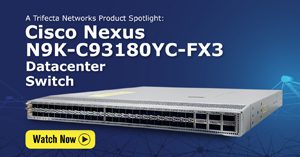
VIDEO: Cisco Nexus N9K-C93180YC-FX3


Resources
🖺 Tech Spec Sheet
Technical Specs
● Cisco Nexus 9000 Series Switches support Cisco Application Centric Infrastructure (Cisco ACI), Cisco NX-OS VXLAN EVPN, Cisco IP Fabric for Media, Cisco Nexus Data Broker, and IP routed or Ethernet switched Layer-2 fabrics using a comprehensive set of unicast and multicast IPv6/IPv4 and Ethernet protocols.
● Purpose-built Cisco NX-OS Software operating system with comprehensive, proven innovations. The operating system is modular, with a dedicated process for each routing protocol: a design that isolates faults while increasing availability.
● Industry-leading Cisco Software-Defined Networking (SDN) solution with Cisco ACI support.
● Support for standards-based VXLAN EVPN fabrics, inclusive of hierarchical multisite support (Refer to VXLAN network with MP-BGP EVPN control plane for more information.)
● Three-tier BGP architectures, enabling horizontal, nonblocking IPv6 network fabrics at web scale
● Comprehensive protocol support for Layer-3 (v4 and v6) unicast and multicast routing protocol suites, including BGP, Open Shortest Path First (OSPF), Interior System to Interior System (IS-IS), Enhanced Interior Gateway Routing Protocol (EIGRP), Routing Information Protocol Version 2 (RIPv2), Protocol Independent Multicast Sparse Mode (PIM-SM), Source-Specific Multicast (SSM), and Multicast Source Discovery Protocol (MSDP)
● Segment Routing (SR and SRv6) allows the network to forward MultiProtocol LabelSwitching (MPLS) packets and engineer traffic without Resource Reservation Protocol (RSVP) Traffic Engineering (TE). It provides a control-plane alternative for increased network scalability and virtualization.
● Cisco IP Fabric for Media helps you migrate from an SDI router to an IP-based infrastructure. In an IP-based infrastructure, a single cable has the capacity to carry multiple bidirectional traffic flows and can support different flow sizes without requiring changes to the physical infrastructure.
● Cisco Nexus Dashboard Data Broker provides customers complete observability into their network and solution(s) that can help them to identify and mitigate security threats, realize and remediate performance bottlenecks, adhere to data compliance, and have insight into capacity-planning operations. Extensive programmability
● Day-0 automation through Power On Auto Provisioning (POAP), drastically reducing provision time
● Industry-leading integrations for leading DevOps configuration management applications, such as Ansible. Extensive Native YANG, and industry-standard OpenConfig model support through RESTCONF/NETCONF/gNMI
● REST API interacting with Data Management Engine (DME)
● Model-driven telemetry enhances network observability
● Third-party application-hosting using Cisco Application Framework (CAF) High scalability, flexibility, and security
● Flexible forwarding tables support up to two million shared entries
● IEEE 802.1ae MAC security (MACsec) capability on all ports, which allows traffic encryption at the physical layer and provides secure server, border leaf, and leaf-to-spine connectivity
● Cisco Nexus 9000 Series Switches support innovative congestion management and flow control algorithms along with the latency and telemetry needed to meet the design requirements of AI/ML fabrics.
● Priority Flow Control (PFC) is a key capability supported on Cisco Nexus 9000 Series Switches that prevents Ethernet frame drops by signaling, controlling, and managing Ethernet flows along the path by sending pause frames to appropriate senders.
● The platform also supports Explicit Congestion Notification (ECN), which provides end-to-end notification per IP flow by marking packets that experienced congestion, without dropping traffic. The platform is capable of tracking ECN statistics, including the number of marked packets that have experienced congestion.
● The platform offers lossless transport for Remote Direct Memory Access (RDMA) over converged Ethernet (RoCE) with support of Data-Center Bridging (DCB) protocols:
● Enhanced Transmission Selection (ETS) reserves bandwidth per priority class in network contention situations
● Data Center Bridging Exchange Protocol (DCBX) can discover and exchange priority and bandwidth information with endpoints.
● Weighted Random Early Detection (WRED) is a congestion avoidance technique that allows Cisco Nexus 9000 Series Switches to detect and react to congestion in the network by marking flows that could cause congestion.
● The platform offers Cisco’s innovative intelligent buffer management, which offers the capability to distinguish mice and elephant flows and apply different queue-management schemes to them based on their network forwarding requirements in the event of link congestion.
● Approximate Fair Dropping (AFD) with Elephant Trap (ETRAP). AFD distinguishes long-lived elephant flows from short-lived mice flows by using ETRAP. ETRAP measures the byte counts of incoming flows and compares them against the user-defined ETRAP threshold. After a flow crosses the threshold, it becomes an elephant flow.
● Dynamic Packet Prioritization (DPP) provides the capability of separating mice flows and elephant flows into two different queues so that buffer space can be allocated to them independently.
● Virtual Port-Channel (vPC) technology provides Layer-2 multipathing through the
elimination of Spanning Tree Protocol (STP).
● Can-do fabric link in the VXLAN environment, eliminating the need for peer-to-peer VPC
● The 64-way Equal-Cost Multipath (ECMP) routing enables the use of Layer-3 fat-tree designs. This feature helps organizations prevent network bottlenecks, increase resiliency, and add capacity with little network disruption.
● Software Maintenance Upgrades (SMUs) contain fixes for a specific defect and provide a quick resolution of critical issues.
● In-Service Software Upgrades (ISSUs) allow upgrades of device software while the switch continues to forward traffic. ISSUs reduce or eliminate the downtime typically caused by software upgrades.
● The switches use hot-swappable Power-Supply Units (PSUs) and fans with N+1 redundancy.
● Cisco Nexus Dashboard is a platform that transforms data-center and cloud-network operations through simplicity, automation, and analytics. Cisco Nexus Dashboard Fabric Controller (NDFC), Cisco Nexus Dashboard Insights (NDI), Cisco Nexus Dashboard Orchestrator (NDO), and Cisco Nexus Dashboard Data Broker (NDDB) are integrated as services into Cisco Nexus Dashboard.
● Cisco Nexus Dashboard is included with all Cisco Nexus 9000 switch tiered licenses. Cisco Nexus Dashboard Fabric Controller requires a Cisco Data Center Networking (DCN) Essentials license, Cisco Nexus Dashboard Orchestrator requires a DCN Advantage license, and Cisco Nexus Dashboard Insights requires a DCN Premier or a DCN Day 2 Ops add-on license.