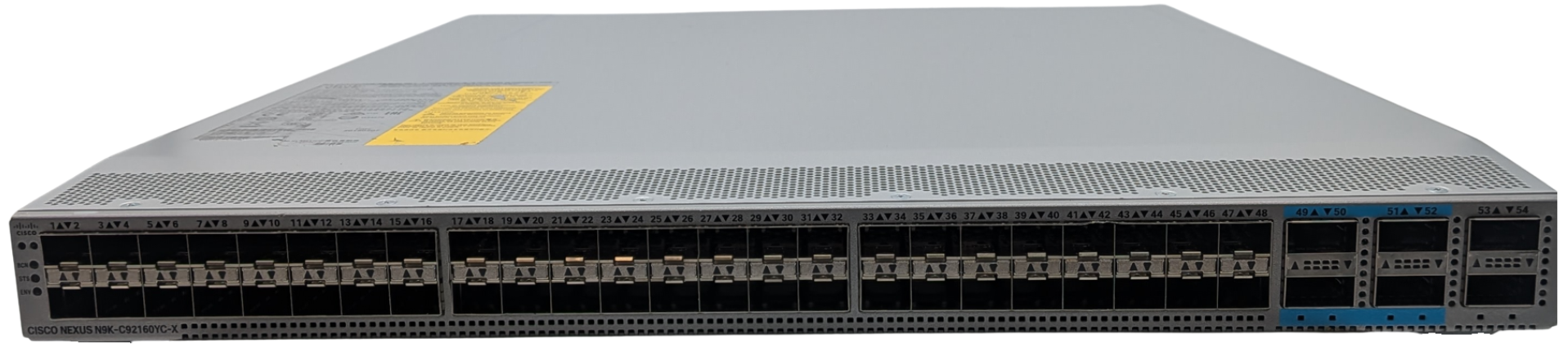
The Cisco Nexus N9K series of datacenter switches are designed for demanding network infrastructure deployments where reliability, performance, and scalability matter most. Providing robust features like API programmability, virtualization, and management insights, the Nexus platform offers a wide variety of architectures from traditional top of rack to spine-leaf that meet the most demanding and challenging data driven environments
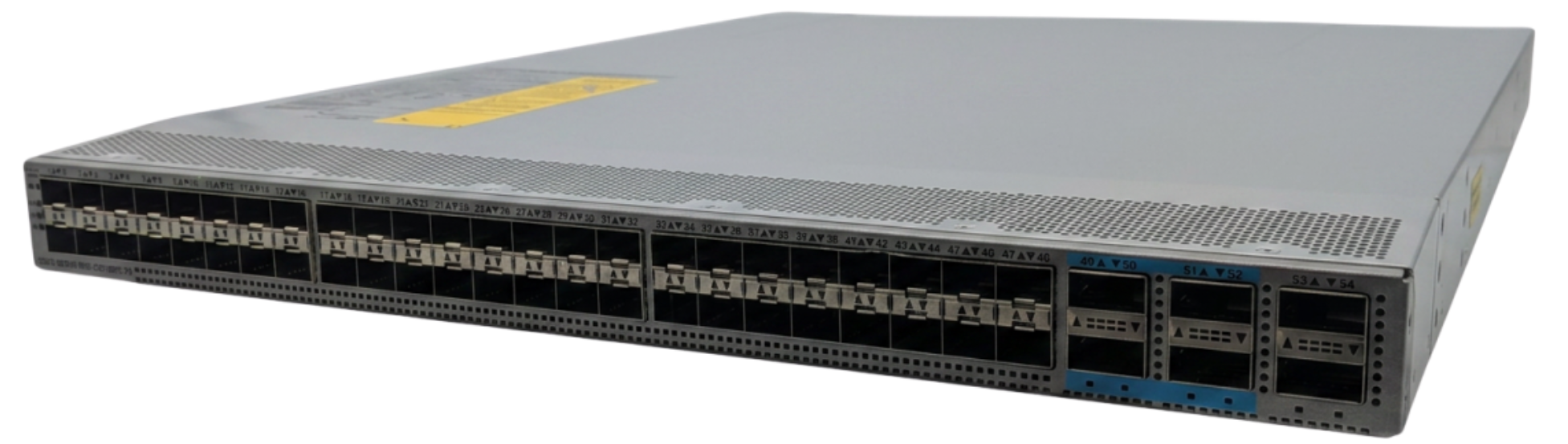
Cisco Nexus N9K-C92160YC-X
Starting at $949* (MSRP $17,920)
- Acess Ports: 48 x 1/10/25Gb SFP+ optical ethernet ports
- Uplink Ports: 6 x 40/100Gb QSFP28 optical ethernet ports
- Features: Available with port side intake or port side exhaust airflow, redundant PSU & fans, NX-OS or ACI firmware
*Pricing listed is not guaranteed. Prices are subject to change at any time, depending on available inventory and market pricing

★ 100% Quality Guarantee ★
★ ISO Certified Testing Facility ★
★ Lifetime Replacement Warranty ★
★ Expertly Packed and Shipped ★
Related Content


Resources
🖺 Tech Spec Sheet
Technical Specs
The Cisco Nexus 9200 platform provides the following features and benefits:
● High performance and scalability
◦ The platform provides wire-rate Layer 2 and 3 switching on all ports, with up to 7.2 Tbps and up to
5.35 bpps of bandwidth.
◦ With up to 40 MB of shared buffer, the platform is an excellent choice for scalable data centers and big
data applications. The ability to fine tune buffer allocation for non-drop queues makes the Nexus 9200
an ideal platform for IP storage designs.
● Virtual Extensible LAN (VXLAN)
◦ The platform (except Cisco Nexus 92348GC-X and Cisco Nexus 92348GC-FX3 ) offers native line-rate
VXLAN routing.
◦ The Border Gateway Protocol (BGP) Ethernet Virtual Private Network (EVPN) control plane provides
scalable multitenancy and host mobility (refer to VXLAN Network with MP-BGP EVPN Control Plane for
more information).
● Hardware and software high availability
◦ The 64-way Equal-Cost Multipath (ECMP) routing enables the use of Layer 3 fat-tree designs. This
feature helps organizations prevent network bottlenecks, increase resiliency, and add capacity with
little network disruption.
◦ Patching ensures undisruptive upgrade in most cases.
◦ The switches use hot-swappable Power-Supply Units (PSUs) and fans with N+1 redundancy.
● Purpose-built NX-OS operating system with comprehensive, proven innovations
◦ Open programmability supports built-in DevOps automation tools such as Puppet, Chef, and Ansible.
◦ Cisco NX-API supports a common programmatic approach across Cisco Nexus switches.
◦ Power-on autoprovisioning (POAP) enables touchless bootup and configuration of the switch,
drastically reducing provisioning time.
◦ The onboard Python scripting engine enables automation and remote operations in the data center.
◦ Advanced buffer monitoring reports real-time buffer utilization per port and per queue, which allows
organizations to monitor traffic bursts and application traffic patterns.
◦ Complete Layer 3 unicast and multicast routing protocol suites are supported, including BGP, Open
Shortest Path First (OSPF), Enhanced Interior Gateway Routing Protocol (EIGRP), Routing Information
Protocol Version 2 (RIPv2), Protocol Independent Multicast Sparse Mode (PIM-SM), Source-Specific
Multicast (SSM), and Multicast Source Discovery Protocol (MSDP).
◦ Segment routing allows the network to forward Multiprotocol Label Switching (MPLS) packets and
perform traffic engineering without Resource Reservation Protocol (RSVP) Traffic Engineering (TE). It
provides a control-plane alternative for increased network scalability and virtualization.